Tuesday, 21 June 2016

Fractions

We've been finding tenths of various amounts this week:

E.g. 3/10 of 40
6/10 of 20 

The children should know this is exactly the same as dividing...
1/10 of 30 is the same as 30 \ 10

When working out 3/10 of 40, the children must work out 1/10 first. Then multiply by the top number.
1/10 of 40 = 4
4 X 3 = 12
So 3/10 of 40 = 12


Thursday, 5 May 2016

Chunking

This is the first method we use to teach division.

It is basically division using a number line


We have also worked through examples that have remainders.


The children will most likely need support with these should you want to practice at home.

 62 ÷ 5 =  _____            ____ x 5 = 62      


Wednesday, 23 March 2016

Multiplication

When multiplying a single digit number with a two digit number we have taught the children to use the 'grid method'.

Like this,

(Partitioning the two digit number)


Try a few at home!
2 x 35
3 x 23
3 x 42


Friday, 26 February 2016

Telling the time

We're back to time again.

This week we've only focused on reading time to the nearest minute PAST, in analogue and digital form.


On Monday we will introduce minutes TO


The children need to be able to read both analogue and digital times AND write them down


Please do ask them to read the time as often as possible. Other great games to practice are:
http://www.maths-games.org/time-games.html


Mangahigh

New challenges have been set!

Column addition
Telling the time
3 and 4 times tables

Column addition

The children have really been getting the hang of using column addition to add 3 digit and 2 digit numbers together.

We teach them to set it out this way...


It is important to leave a line above the answer box so they can write any number they have carried over. If they have already learnt to carry and write underneath, then it's fine to stick with that method.

Friday, 29 January 2016

Doodle Maths

Just thought I'd share this great app with you. It's fun and simple to use, and a good one for basic number skills and times tables!

https://play.google.com/store/apps/details?id=com.ezeducation.doodlemaths.ks2&hl=en


Finding fractions of amounts


Being able to work these out relies heavily on knowing times tables. So please do continue practising so that your child knows their 3s and 4s by heart.


Friday, 22 January 2016

Fractions!

This week we've been having fun with fractions.


Adding parts to make a whole:


Equivalent fractions:


Friday, 8 January 2016

3 digit numbers

Back to place value again... we've been ordering, comparing, and finding numbers on number lines.

We've also been adding and subtracting 100s, 10s and 1s. 

If you practise this at home, I've been encouraging the children to follow these steps to help them...

1) write H T U above the 3 digit number
2) work out which digit is changing, H T or U
3) write down those that stay the same in the correct place
4) add or subtract 

E.g.


We played games where I hid various parts of sums, and the children had to work out what was missing. They responded really well to this challenge and were keen to do more, so you might want to give it a go at home.


CHALLENGE!


Wednesday, 9 December 2015

Happy Christmas!

The children have worked very hard this term, and above all, deserve a big rest this holiday!

I have signed the group up to mangahigh (a games-based maths website where the children can earn medals and compete against one another). It is a really great way to reinforce and practise those basic number skills.
Each child has their login details stuck into their planner.


They are free to play games as they wish, but I have also assigned specific tasks to the group (which the children can find under 'my list'.) I can therefore track their progress and see what  they've been up to.

Have a lovely Christmas break all!
Best wishes
Miss Durkin

Monday, 30 November 2015

Times and divide as inverse operations

Today we explored multiplication and division as opposites.

Give children 3 numbers - they can use the numbers to make two multiplication sums
                                                                                             and two division sums

Inverse game


You can give your child 3 numbers (multiples of 2,3,4,5 only) and see if they can come up with the 4 sums.

This is what we have been doing in class:


Rounding to the nearest 100

 Start with a 3 digit number...

346

1) What two hundreds does it lie between?
2) Which hundred is it closest to? Would be round up or down?

To answer the second question, I have encouraged the children to look at the tens column. If it is less than 50 round down, or 50 or above, round up.

It is also good to draw it out and make a blank number line, so it is very visual for them.
If they do this, they should find the number that lies half way between them and mark it on the number line. They may also want to mark on the tens. Then they can clearly see whether it is above or below and so know which way to round.


Friday, 20 November 2015

Measuring length

Rulers and tape measures have been out this week!

The children have been estimating, measuring and recording length to the nearest half cm.

We have briefly looked at mm, but the children don't need to worry about being too accurate yet - reading to the nearest half cm is fine for now.
Of course, if appropriate, you could have a go!

When recording halves, the children should use .5, they should know this is because it is 5 little mm along.


Length games


Thursday, 12 November 2015

Next week...

Number bonds to 100!

Starting by recapping our number bonds to 10

Adding and subtracting 10p!

We've been both cutting and increasing prices today - involving adding and subtracting multiples of 10.

i.e. £2.10 + 10p = 

      £3.45 - 10p =

      £2.25 + 30p =

      £4.48 - 30p =


To make this easier, I have encouraged the children to write HTU (hundreds, tens, units) above the appropriate digit first. This way they can identify what the tens number is, as this is the only number that will change.


It is a good idea to always begin with adding and subtracting just 10p, and then progress to other multiples of 10.

You can have a go at pricing a few items at home and setting up a shop. Slash prices for the day or put them up as a way to raise some extra money for charity!


We have also talked about the importance of using zero as a place holder, when there are no tens.
i.e. writing £5.08 instead of £5.8


Friday, 6 November 2015

Money

Today we started to look at money, and will be focusing on this next week.


The children will be learning to:

*Identify the names of all the coins (1p, 2p, 5p, 10p, 20p, 50p, £1, £2) and use them to make varying amounts. 

*Read and record amounts of money using £ and p, including use of zero i.e. £3·05

*Use place value to solve problems and add and subtract amounts of money


Here are some great games, if you would like to have a go with your child:


Sort, count and order
Giving change - subtracting
Igloo shopping
Shopping bag
Pay using 1 coin


Tuesday, 3 November 2015

Fractions

We have been exploring fractions this week - helping the children to understand fractions as parts of wholes.

The fraction wall helps with this


The children should realise that each part must be equal, and the bigger the 'number at the bottom', the smaller the part is.
You can ask questions like... 'which is bigger, 1/2 or 2/6?' etc. They can use the wall to help.


These are great games the children really like:


We have also been finding fractions of given amounts too. The children will need counters or cubes or coins, something they can split up.

Can you find:
1/2 of  16   (they should know this by heart)
1/3 of 15
1/4 of 20   etc.
Try 2/3 3/4 etc. when confident 

Try this...  Would you rather?

Place value cards

These cards are great visual and kinaesthetic tools to help the children understand the value of two and three digit numbers, and develop their understanding of number in general.


Building and pulling apart numbers to help add, subtract, double, half etc., or just let them experiment with them. 

Games such as:

Who can build...

the largest number? smallest number?
a number in between 600 and 700?
a number that rounds to 70?
a number that is closest to 30?
a number less than 124? etc.


Use a different colour for each card 

Doubling and halving

The children should be able to recall the doubling and halving facts up to 20 pretty quickly.
If they are still a bit wobbly, then please do practise these little and often...whenever you get a spare minute.


i.e. double 6 is 12
double 7 is 14
double 9 is 18

half of 12 is
half of 16 is

These games will help:
stage 1
stage 2


The children enjoyed testing themselves using this machine:
Doubling and halving machine

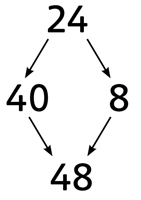
When moving onto to doubling and halving 2 digit numbers, we encourage the children to make diamonds. This encourages them to split the number into tens and units, working on one side at a time.


Like this,


   Doubling diamond


                                     Halving diamond

Here is a good game to practise both. You can change the level of difficulty.

When halving, use numbers where both the tens and digits are even. i.e 24, 48, 62 etc. Then move onto odd.